Top 7 AI Models Transforming Industries in 2026: A Comprehensive Overview

Understanding AI Models

What constitutes an AI model extends beyond just algorithms; it includes data, frameworks, and computational power. An AI model is a mathematical representation designed to perform specific tasks by learning from vast datasets.
Key Functions and Applications in Business
AI models serve various functions in the business landscape, including:
Predictive Analytics: Analyzing trends to forecast future outcomes.
Natural Language Processing (NLP): Understanding and generating human language for customer service automation.
Image Recognition: Automating the identification of products or services based on images.
Recommendation Systems: Personalizing user experiences by suggesting products based on behavior and preferences.
These functions enable businesses to enhance decision-making, streamline operations, and improve customer interactions. For more about AI models and their functionalities, see also: AI Models: Types, Examples, and Everything You Need to Know - Domo.
Real-World Examples of AI Model Usage
AI models have transformed numerous industries with their applications. Here are notable examples:
Finance: Banks utilize AI models for fraud detection, identifying suspicious transactions in real-time.
Retail: E-commerce platforms leverage recommendation systems powered by AI to enhance user engagement and increase conversion rates.
Healthcare: AI models analyze medical images, helping radiologists detect anomalies quickly and accurately.
Marketing: Businesses employ chatbots, using NLP models, for efficient customer service and lead generation.
"AI models are not just tools; they are essential gears that drive modern business innovation."
Businesses looking for sophisticated solutions benefit greatly from deploying self-hosted AI systems. StartClaw.ai simplifies this journey with its 1-click deployment feature, enhancing accessibility and functionality.
AI models continuously evolve, adapting to new challenges and demands. Companies can stay ahead by integrating these advanced models for potential growth and increased efficiency.
Types of AI Models
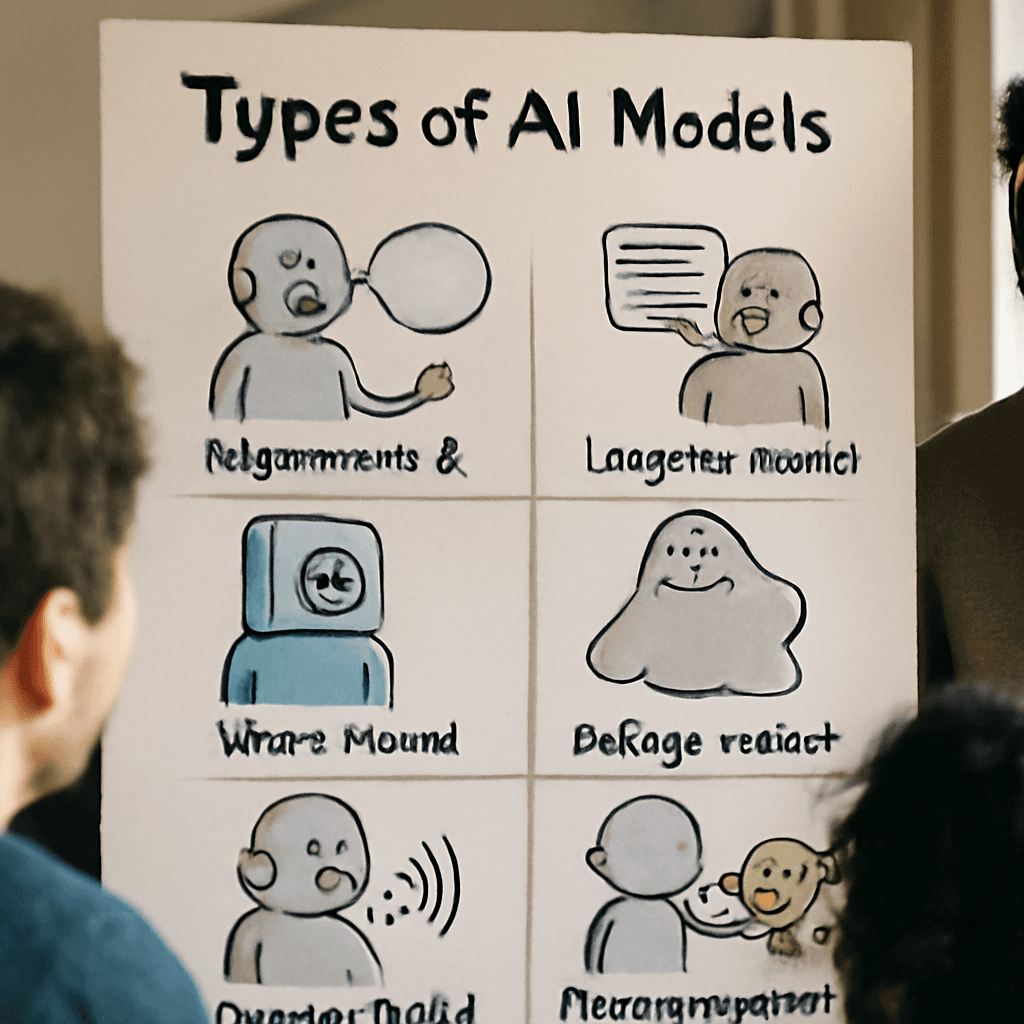
AI models can be categorized into several types, each designed for distinct applications and tasks. Understanding these types is essential for organizations looking to implement self-hosted solutions like the ones provided by StartClaw.ai.
Supervised Learning Models
Supervised learning models operate using labeled datasets. They learn from input-output pairs, enabling them to predict outcomes when presented with new data. Common applications include:
Image recognition: Identifying objects in photographs.
Spam detection: Classifying emails as either relevant or spam.
Predictive maintenance: Anticipating equipment failures.
These models rely heavily on the quality and quantity of labeled data to enhance their accuracy. For a deeper understanding, you can explore what constitutes an AI model according to IBM.
Unsupervised Learning Models
Unlike supervised models, unsupervised learning models process unlabelled data. They seek patterns and structures without prior outcomes. Key uses of unsupervised learning include:
Clustering customer segments: Grouping users by behavior for targeted marketing.
Anomaly detection: Identifying irregularities in transactions or system performance.
Dimensionality reduction: Simplifying datasets while retaining essential features.
This flexibility helps businesses extract insights from vast amounts of data without requiring extensive labeling.
Reinforcement Learning Models
Reinforcement learning models learn through trial and error. They interact with an environment, receiving feedback in the form of rewards or penalties. This method is particularly effective in:
Robotics: Training robots to perform tasks efficiently.
Game AI: Developing intelligent agents that improve through gameplay.
Autonomous vehicles: Navigating complex environments with dynamic elements.
Reinforcement learning emphasizes the importance of maximizing rewards over time, making it versatile and adaptive.
Generative Models
Generative models create new data by learning the underlying distribution of existing datasets. They are gaining traction in various industries for purposes such as:
Content generation: Producing text, images, or music based on learned styles.
Synthetic data: Creating realistic datasets for training other AI models without privacy concerns.
Design: Assisting in architecture by generating innovative structural models.
These models are revolutionizing how creative industries approach content and product development, proving invaluable for businesses seeking innovative outputs.
By understanding these AI model types, organizations can make informed decisions about which solutions best fit their unique needs. Particularly with the ease of deployment offered by StartClaw.ai, integrating these models into business operations becomes a streamlined process.
Top AI Models You Should Know in 2026
Companies across the globe are increasingly adopting AI models to enhance efficiency and innovation. Understanding the landscape and capabilities of these models is essential for businesses exploring self-hosted solutions.
Overview of the Most Adopted Models
In 2026, several AI models stand out due to widespread adoption. Among these are:
GPT-4 Enhanced: Known for its language processing capabilities, it excels in natural conversation and content generation.
BERT: With its focus on understanding context in search queries, it remains invaluable for businesses in maximizing SEO effectiveness.
DALL-E 3: This model revolutionizes creative fields by generating images from textual descriptions, proving essential for marketing and design industries.
These models are not only popular but integral to business processes, enhancing productivity and user experiences. For detailed insights on what makes an AI model impactful, refer to A Guide to AI Models: What They Are and How They Work - Snowflake.
Key Features of Leading AI Models
Leading AI models of 2026 exhibit certain common features that enhance their functionality:
Scalability: The ability to handle an increasing load is vital for businesses seeking to remain agile.
Interoperability: Many models can seamlessly integrate with existing software and platforms, minimizing setup complexities.
Real-time Processing: Models now offer near-instantaneous decision-making, critical for industries where speed is a factor.
"The most successful AI implementations occur when the technology integrates easily with existing processes."
Understanding these key features can guide organizations in choosing the right model to suit their specific needs.
Emerging AI Models to Watch
Several emerging AI models are gaining traction, promising innovative solutions:
MediBot: Designed for healthcare, it employs AI for patient diagnostics and personalized treatment plans, potentially transforming patient care.
EcoAI: Focused on sustainability, this model analyzes environmental impacts, helping businesses comply with regulations while optimizing operations.
AptText: A natural language processing model specifically aimed at enhancing professional writing and editing tasks, gaining popularity in corporate settings.
Monitoring these models can provide insight into future trends and technology advancements for AI integration.
Comparing AI Models: Performance and Suitability
Performance metrics play a crucial role in evaluating AI models. Key metrics include:
Accuracy: Measures the model's ability to correctly predict outcomes.
Precision and Recall: Important for assessing relevance in tasks like classification.
F1 Score: A balance of precision and recall, especially valuable for imbalanced classes.
Inference Time: Indicates how quickly a model can make predictions, essential for real-time applications.
Resource Efficiency: Evaluates the computational requirements needed, which impacts deployment in self-hosted environments.
Competitor Analysis: Strengths of Models from StartClaw.ai and Others
StartClaw.ai distinguishes itself with the OpenClaw AI Assistant, designed for seamless deployment and integration. Key strengths include:
1-Click Deployment: Simplifies the setup process, reducing time and technical expertise required, making it ideal for businesses without extensive IT resources.
Integration with Messaging Platforms: Facilitates easy connectivity with services like Telegram, WhatsApp, and Slack, enabling organizations to implement AI solutions across popular channels effectively.
In contrast, competitors like OpenClaw.org or MyClaw.ai may offer unique features or model variations but often require complex configurations, creating potential barriers for users.
“Efficiency in deployment is as important as the AI model's capability itself.”
Which Model Best Fits Your Needs?
Assessing what AI model suits your needs best depends on several factors:
Business Goals: Identify whether your primary goal is customer engagement, data analysis, or automation.
Technical Resources: Evaluate your team's capability to manage installation and maintenance. StartClaw.ai's platform is user-friendly, making it accessible for non-tech professionals.
Scalability: Consider how easily a model can adapt as your requirements change. A model that allows for easy upgrades will secure your investment longer.
Support and Community: Robust support can significantly enhance your implementation experience. Choose a model that offers strong community support or customer service.
By focusing on the unique strengths of each model and your specific requirements, you can make a more informed decision.
The Future of AI Models
Trends and Innovations on the Horizon
AI models are on the brink of significant transformations, influenced by emerging technologies. Key trends include:
Generative AI: Models are now capable of creating realistic text, images, and sounds, enabling new applications in marketing and entertainment.
Federated Learning: This approach allows models to learn from decentralized data, enhancing privacy and security.
Explainable AI (XAI): There is increasing demand for transparency in AI decision-making, allowing businesses to trust AI outputs.
These trends pave the way for more robust and ethical AI applications across all sectors.
How AI Models are Evolving with Technology
AI models are evolving due to advancements in several key areas:
Computational Power: Faster GPUs and TPUs allow for more complex models, increasing performance and enabling real-time predictions.
Data Availability: The explosion of data from IoT devices and social media feeds provides richer datasets for training models.
Improved Algorithms: Innovations in machine learning techniques optimize learning and enhance efficiency.
These advancements make self-hosted AI solutions more feasible for businesses, reducing barriers to entry. For further insights into the evolution of AI models, you may refer to What is an AI model? | Google Cloud.
Predictions for AI Model Impact in Various Industries
The impact of AI models is predicted to be profound across industries:
Healthcare: Expect enhanced diagnostic tools that leverage AI for faster, more accurate patient assessments.
Finance: AI models will streamline fraud detection and improve personalized customer service.
Retail: Predictive analytics will optimize inventory management and enhance customer targeting.
"AI will redefine the efficiency of operations across sectors, enabling businesses to respond to customer needs instantaneously."
As these technologies mature, businesses embracing self-hosted AI solutions, like those offered by StartClaw.ai, will be well-positioned to leverage these advancements for competitive advantage.
Streamlining AI Deployment with StartClaw.ai
Integrating AI solutions into businesses can often feel daunting due to complex setups and long deployment times. StartClaw.ai addresses these pain points effectively with a streamlined approach for deploying OpenClaw instances.
1-Click Deployment for OpenClaw Instances
With StartClaw.ai, simplicity is paramount. The 1-click deployment feature allows users to launch their AI instances effortlessly. This means no more grappling with intricate terminal commands or cumbersome Docker configurations.
Instant setup: Begin utilizing AI support within minutes.
User-friendly: The deployment process is tailored for both technical and non-technical users.
This approach significantly accelerates the timeline from concept to execution.
User-Friendly Integration with Messaging Platforms
In 2026, connectivity is key. StartClaw.ai ensures seamless integration with popular messaging platforms such as Telegram, WhatsApp, and Slack.
Wide accessibility: Your AI assistant can engage users across various platforms.
Consistent experience: Integration maintains the same responsive, interactive experience for users.
The ease of connecting with existing communication channels knocks down barriers, making it easier for businesses to implement AI-driven solutions.
Availability of AI Support Around the Clock
In an increasingly global and remote work environment, 24/7 accessibility is essential. StartClaw.ai guarantees that your AI assistant is always available, no matter the hour.
Uninterrupted service: Respond to customer inquiries instantly, regardless of time zones.
Boost productivity: Round-the-clock support allows for efficient task management.
This constant availability empowers users to leverage AI assistance whenever needed, resulting in enhanced productivity.
“With StartClaw.ai, organizations can deploy AI instantly, connect with users effortlessly, and provide support around the clock. This transforms how businesses operate.”
Continuous advancements in AI tools further elevate the significance of such solutions, positioning StartClaw.ai as a leader in the space.
FAQs about AI Models
What are the 4 models of AI?
AI can generally be categorized into four primary models:
Reactive Machines: These are the most basic AI models, which respond to specific stimuli without memory or prior experience. They excel in handling well-defined tasks.
Limited Memory: These models learn from past data to inform future decisions. They utilize past experiences to recognize patterns but do not retain them permanently.
Theory of Mind: This more advanced model is still in development. It aims to understand emotions, beliefs, and other mental processes, allowing for social interactions with humans.
Self-aware AI: This conceptual stage represents a future AI that possesses self-awareness and consciousness. Its development is highly speculative and raises ethical questions.
What are the best AI models for businesses?
Choosing the right AI model depends on business needs. Here are some leading models for various applications:
Natural Language Processing (NLP): Models like GPT-4 and BERT are ideal for tasks involving text analysis, chatbots, and customer service.
Computer Vision: Convolutional Neural Networks (CNNs) serve effectively in image recognition and processing tasks.
Reinforcement Learning: Useful in scenarios such as robotics and game playing, allowing models to learn through trial and error.
Generative Adversarial Networks (GANs): Valuable for content creation, GANs help improve marketing materials or generate synthetic data.
What are the major AI models currently used?
As of 2026, the AI landscape sees several prominent models transforming businesses:
Transformer Models: Revolutionizing NLP, models like OpenAI’s ChatGPT and Google’s BERT continue to set benchmarks in text generation and understanding.
BERT and its Variants: These models are widely used for search engines and recommendation systems, improving context understanding.
ResNet: A CNN model that aids in image classification and analysis, ResNet is extensively used in industries ranging from healthcare to automotive.
AutoML: Automated machine learning frameworks streamline model selection, making AI accessible to non-experts.
How do AI models vary in terms of functionality?
AI models differ significantly based on their intended applications:
Task Specialization: Some models excel in specific tasks, such as chatbot functionalities, while others are more general-purpose.
Learning Paradigms: Variations include supervised learning, unsupervised learning, and reinforcement learning, each catering to different operational needs.
Scalability: Some models can adapt to larger datasets without loss in performance, while others may struggle under heavy loads.
Training Requirements: The complexity of training varies, influencing operational costs and implementation timelines.
What is the future outlook for AI models?
The future of AI models is promising, with trends pointing toward:
Increased Automation: As AI becomes more integrated into everyday business functions, expect automation and improved efficiencies.
Personalization: Models are likely to evolve towards providing highly personalized experiences, from tailored marketing to individualized customer interactions.
Ethical AI: As awareness of AI ethics grows, future models will prioritize fairness, transparency, and accountability.
User-friendly Interfaces: The demand for self-hosted solutions, like those offered by StartClaw.ai, will increase. This allows non-technical users to leverage powerful AI models without complex setups.
For more information on AI models and their impact, consult resources such as What are AI Models? | Glossary | HPE.